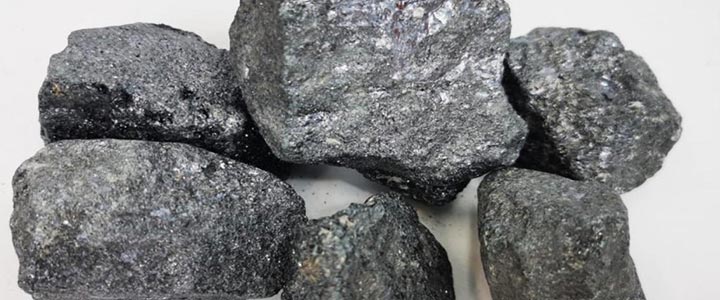
Silicon Carbon Alloy, a new alloy material, is widely used in the steelmaking industry. It performs diffusion deoxidation, shortens deoxidation time, saves energy, is inexpensive, improves steelmaking efficiency, reduces raw material consumption, and reduces environmental pollution. Furthermore, Silicon Carbon Alloy contains a certain amount of carbon, so it can also increase carbon content, playing a crucial role in improving the overall efficiency of electric furnaces. To provide a deeper understanding of the benefits of Silicon Carbon Alloy, let's explain its main components and functions.
The silicon in Silicon Carbon Alloy has a good deoxidizing effect on molten steel. Silicon can also be used as an alloying element in steel, generally with a mass fraction of no less than 0.4%. It exists as a solid solution in ferrite or austenite, reducing the area of the austenite phase. Increasing the annealing, normalizing, and quenching temperatures can improve the hardenability of hypoeutectoid steel.
Silicon does not form carbides, which strongly promote the graphitization of carbon. Carbon steels with high silicon content and those without strong carbide-forming elements are prone to graphitization at certain temperatures. Silicon improves the strength and localized corrosion resistance of ordinary low-alloy steels, as well as the hardenability and tempering resistance of quenched and tempered steels. It is one of the main alloying components of multi-component SiN or SiMnB steels, with silicon contents ranging from 0.5% to 2.8%. These steels are widely used in high-load springs, along with strong carbide-forming elements such as tungsten, vanadium, molybdenum, niobium, and chromium.
Carbon is the primary alloying element in steel, so it is also called an iron-carbon alloy. Carbon's primary role in steel is to form solid solution structures, enhancing its strength. For example, in ferrite and austenite, the presence of carbon increases the hardness and wear resistance of steel by forming carbides. For example, cementite (Fe3C) is a carbide structure.
Therefore, a higher carbon content in steel increases its strength and hardness, but also reduces its plasticity and toughness. Conversely, a lower carbon content increases its plasticity and toughness, but reduces its strength and hardness.
For more information, please contact us.


 English