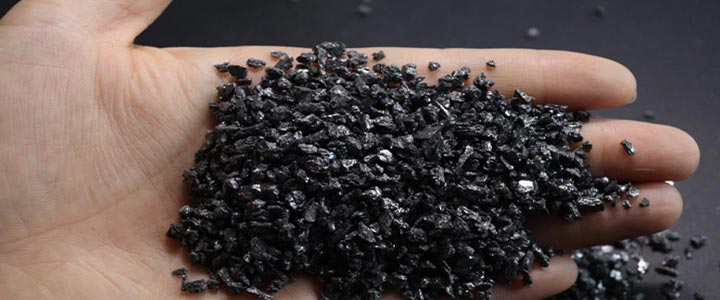
Beyond abrasives, Silicon Carbide has numerous applications due to its stable chemical properties, high thermal conductivity, low thermal expansion coefficient, and excellent wear resistance. For example, a special coating process using powder on turbine impellers or cylinder walls can improve wear resistance and extend service life by 1-2 times. High-grade refractory materials produced using this method offer thermal shock resistance, compact size, light weight, high strength, and energy efficiency. Low-grade Silicon Carbide (containing approximately 85% SiC) is an excellent deoxidizer, accelerating steelmaking, controlling chemical composition, and improving steel quality. Silicon Carbide is also widely used in the manufacture of silicon carbide rods for heating elements.
Silicon Carbide is extremely hard, with a Mohs hardness of 9.5, second only to the world's hardest diamond (grade 10). It is a semiconductor with excellent thermal conductivity and oxidation resistance at high temperatures.
Silicon carbide has a specific gravity of 3.2 g/cm3 and a high sublimation temperature (approximately 2700°C), making it suitable as a raw material for bearings or high-temperature furnaces. It does not melt at any achievable pressure and has very low chemical activity. Due to its high thermal conductivity, high breakdown electric field strength, and high current density, many are seeking to replace silicon in high-power semiconductor components. Furthermore, it strongly couples with microwave radiation, and its high sublimation point makes it useful for heating metals.
Pure Silicon Carbide is colorless; its industrial brown to black color is due to iron impurities. The iridescent sheen on the crystals is caused by a protective layer of silicon dioxide on the surface.
The above is information on the material properties of Silicon Carbide, as provided by Silicon Carbide manufacturers. For more information, please contact us.


 English