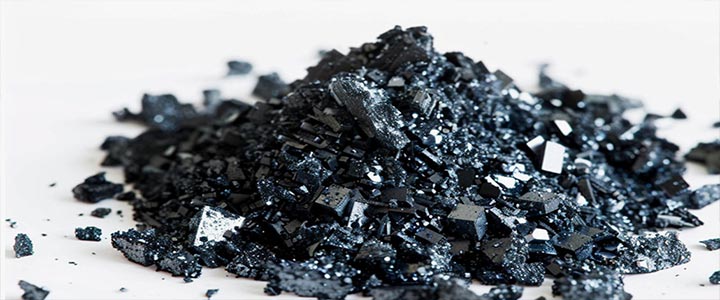
Silicon carbide, also known as corundum (SiC), is produced by smelting raw materials such as quartz sand, petroleum coke (or coal coke), and sawdust (salt is added when producing green silicon carbide) at high temperatures in a resistance furnace. Silicon carbide also occurs naturally in the rare mineral moissanite. Silicon carbide is also known as carbon silicon stone. Among contemporary high-tech non-oxide refractory materials such as C, N, and B, industrially produced Silicon Carbide is divided into black Silicon Carbide and green Silicon Carbide. Both are hexagonal crystals with a specific gravity of 3.20-3.25 and a microhardness of 2840-3320 kg/mm².
Silicon Carbide has four main application areas: functional ceramics, high-refractories, abrasives, and metallurgical raw materials. Silicon Carbide coarse materials are already available in large quantities and cannot be considered a high-tech product. However, the application of nano-scale Silicon Carbide powders, which require extremely high technical content, is unlikely to achieve economies of scale in the short term. Silicon carbide can be used as an abrasive in abrasive tools such as grinding wheels, oilstones, grinding heads, and sanding tiles. It also serves as a metallurgical deoxidizer and high-temperature resistant material. High-purity single crystals can be used in semiconductor manufacturing and silicon carbide fiber production.
Silicon carbide is primarily used for wire sawing of 3-12-inch single crystal silicon, polycrystalline silicon, potassium arsenide, and quartz crystals. It is also an engineering processing material for the solar photovoltaic, semiconductor, and piezoelectric crystal industries.
Silicon carbide is used in semiconductors, lightning rods, circuit components, high-temperature applications, UV detectors, structural materials, astronomy, disc brakes, clutches, diesel particulate filters, filament pyrometers, ceramic films, cutting tools, heating elements, nuclear fuel, jewelry, steel, protective gear, and catalyst carriers.
As abrasive tools, Silicon carbide is primarily used in the production of grinding wheels, sandpaper, sanding belts, oilstones, grinding blocks, grinding heads, and abrasive pastes, as well as for grinding and polishing single crystal silicon and polycrystalline silicon used in photovoltaic products and piezoelectric crystals used in the electronics industry.


 English