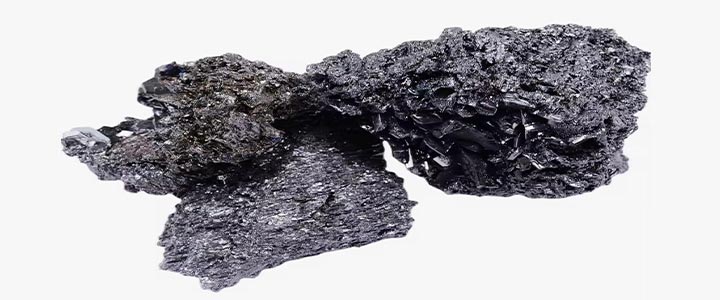
Silicon Carbide, as a metallurgical refractory material, is widely used in the current market. Abrasives and refractories are the primary applications for silicon carbide. Abrasives typically use single-size particles, while refractories often use mixed particle sizes. The following describes several applications of silicon carbide.
1. Chemical Applications: In chemical applications, Silicon Carbide primarily acts as a purifying agent in the steelmaking industry. It melts steel, reacting free oxygen and metal oxides in the molten steel to produce carbon monoxide and silicon-containing slag. Adding Silicon Carbide to cast iron smelting introduces a small amount of silicon into the molten iron, thereby purifying the cast iron structure and improving the quality of the casting.
2. Electrical Applications: In the electrical industry, Silicon Carbide is primarily used as heating elements, nonlinear resistors, and high-temperature semiconductor materials. Silicon Carbide heating elements are commonly found in silicon carbide rods used in various electric furnaces operating at temperatures between 1100°C and 1500°C. These rods can oxidize and foam in operating environments exceeding 1500°C. 3. Abrasives: Silicon carbide is a versatile abrasive due to its high hardness, chemical stability, and moderate toughness. It can be used in bonded and coated abrasives, as well as for free-grinding applications. Because it reacts less strongly with certain materials and is relatively hard among common abrasives, it is often used in processing non-metallic materials such as glass, ceramics, and stone, as well as difficult-to-grind colored materials such as carbide and titanium alloys. However, diamond is competing with it in many abrasive applications.
4. Refractory Materials: Silicon carbide is widely used in refractory materials due to its high melting point, inertness, and thermal shock resistance. Pressing and sintering, pressing and recrystallizing, casting and recrystallizing, and vapor deposition of silicon carbide onto carbonaceous materials are among the most popular methods currently used in the market. These methods effectively maximize the refractory properties of silicon carbide.
5. Others: Silicon Carbide can be formulated into infrared radiation coatings or manufactured into sheets for use in infrared radiation dryers. Silicon Carbide fiber is being produced in some countries. It can also be used as a component in composite structural materials.
For more information about Silicon Carbide, please contact us.


 English